Revenue Share vs. Equity-Based Model: Which Model Fits Your Business?

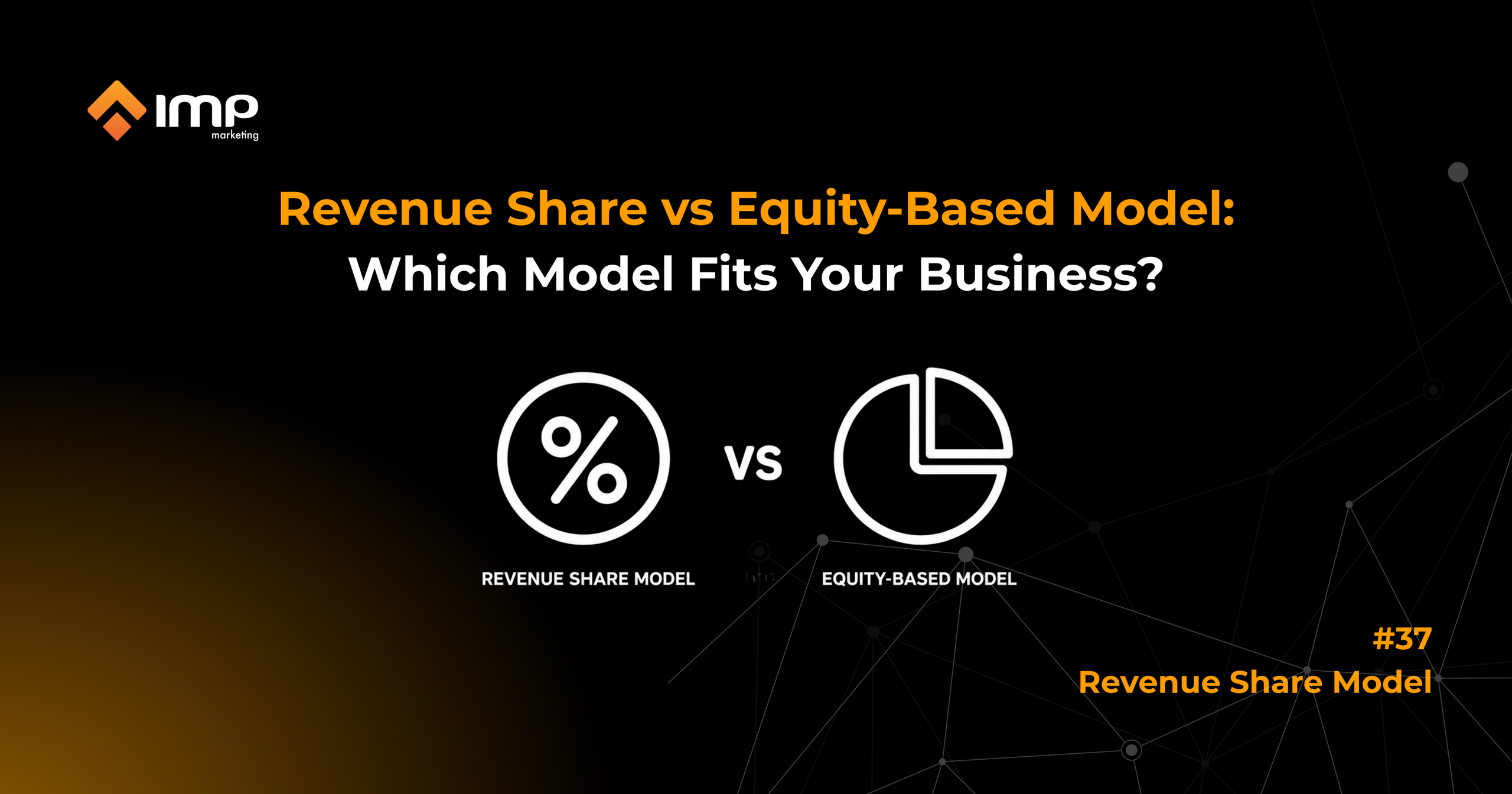
As you explore different agency partnership models, you may reach a point where you want someone more deeply involved in your business, such as a long-term strategic partner. At that stage, two models are worth considering: equity (ownership in your company) and revenue share (a percentage of the revenue it helps generate).
Before deciding which approach is the better fit, you should consider three key factors: ownership, financial commitment, and long-term growth strategy.
1. What Are Revenue Share and Equity-Based Marketing Partnerships?
In a revenue share partnership, the agency earns a base fee plus an agreed percentage of the revenue it helps generate. Because part of its compensation depends on business performance, the agency has a direct financial incentive to improve revenue.
In an equity-based partnership, the agency receives an ownership stake in your company. Instead of being fully paid in cash, part of the agency’s compensation may be reduced, deferred, or exchanged for equity. As a result, the value the agency receives depends on the long-term growth of your business rather than only the revenue generated during the partnership.
2. How Do Revenue Share and Equity-Based Models Affect Ownership and Control?
The biggest difference is whether you keep full ownership of your company or share part of it with the marketing agency.
With a revenue share partnership, you share part of the revenue while retaining ownership of the company. The agency may influence marketing and growth decisions, but it does not automatically gain shareholder or voting rights. At IMP, all accounts remain under your ownership, including any new accounts created during the partnership. Our team only receives the access needed to manage the work. This means that when the revenue share partnership ends, all accounts, data, and assets remain with you, and we make sure everything is properly handed over.
With an equity-based partnership, you give part of your company’s ownership to the marketing agency or its representatives. Depending on the shareholder agreement and share structure, the agency may receive shareholder rights, voting rights, and a share of the company’s future value. Even if the agency stops providing marketing services, the equity that has already vested usually remains with the agency.
3. How Does Each Model Affect Your Financial Commitment?
The two models reduce financial pressure in different ways.
With an equity-based marketing partnership, you may gain access to experienced marketing support without paying the full market-rate fee upfront. The agency may accept a lower retainer, exchange part of its unpaid fees for equity, and invest more senior expertise into helping your startup grow. This reduces your short-term cash flow pressure.
However, if your company grows significantly, the equity may become much more valuable than the original service fee. The agency may continue benefiting from dividends, future funding rounds, acquisitions, or an IPO. Depending on the shareholder agreement, the agency may also face dilution or be asked to participate in future funding rounds.
With a revenue share partnership, a larger portion of the agency’s compensation rises and falls with business performance. As revenue grows, the amount you pay may increase significantly, potentially reaching ten times the original amount. However, unlike equity, the revenue share model is generally more flexible than equity because both parties can renegotiate the revenue share rate over time to keep the partnership fair as the business grows.
GROW WITH A PARTNER THAT HAS SKIN IN THE GAME
IMP combines strategy, execution, and ongoing growth support with compensation tied more closely to your results.
EXPLORE MORE
4. Which Growth Strategy Fits Each Model Better?
Startups should evaluate their long-term growth and exit strategy before choosing between equity and revenue share. If your business is aiming for rapid expansion and a potential acquisition or IPO, an equity-based partnership may be a better fit because both you and the agency benefit from the long-term increase in company value.
Conversely, revenue share may be a better fit for businesses focused on improving measurable revenue without introducing another shareholder into the company.
When Does Equity Make Sense, and When Does Revenue Share Make Sense?
← SWIPE HORIZONTALLY TO VIEW FULL TABLE
| Equity May Be More Suitable | Revenue Share May Be More Suitable |
|---|---|
| An early-stage startup is still building its growth foundation. | Business already has an established product-market fit. |
| Build long-term enterprise value, prepare for fundraising, acquisition, or IPO. | Increase measurable revenue while maintaining full ownership. |
| High uncertainty, long payback period, and significant opportunity cost for the agency. | Lower uncertainty because performance can be measured through business results. |
| The agency accepts lower cash compensation in exchange for future ownership. | The agency is rewarded based on attributable revenue generated. |
The decision should ultimately depend on the type of contribution the business expects from the agency.
How Can a Hybrid Partnership Combine Equity and Revenue Share?
Many founders choose to combine both equity and revenue share. This approach allows you to avoid giving away too much equity to the agency while still creating strong incentives for long-term growth.
As the business grows, adjusting a pure equity arrangement can become difficult and may create conflicts over ownership and value. By keeping the equity portion relatively small and using revenue share to reward near-term performance, both sides have more flexibility to adjust the partnership over time and keep it fair.
Depending on the agreement, the agency may receive a reduced retainer, a percentage of attributable revenue, and a small equity stake that vests over time or after agreed milestones. This gives the agency meaningful upside in both scenarios: if the company achieves a successful exit, the equity increases in value; if the business generates strong cash flow, the revenue share provides ongoing compensation.
Conclusion
The right model depends on what the business needs from the agency at its current stage. Revenue share is more suitable when the company already has a working foundation and needs a partner to improve measurable growth. Equity may be more appropriate when the agency joins earlier, accepts greater uncertainty, and contributes to the company’s development.
Founders should therefore evaluate more than the immediate cost of each model. They should consider how much control they are willing to share, how the agency’s contribution will be valued, and whether its reward should be tied to current revenue or the company’s long-term value.
Revenue Share Partnership FAQs
1. Does a revenue share marketing agency gain ownership or voting rights in the business?
A revenue share marketing agency does not automatically gain ownership or voting rights because its compensation is tied to revenue rather than company equity. The founder generally keeps full ownership of the business, while the agency receives the access needed to support marketing and growth. When the revenue share partnership ends, business accounts, data, and assets remain with the company unless the agreement states otherwise.
2. Can the revenue share rate be renegotiated as the business grows?
Yes. A revenue share rate can be renegotiated over time when the scale of the business, agency involvement, or economics of the partnership change. As revenue grows, the agency’s compensation may increase significantly, so both sides may need to revisit the structure to keep the revenue share agreement sustainable and fair over the long term.
3. Can a revenue share partnership include a small equity component?
Yes. Some partnerships combine a base fee, revenue share, and a small equity stake. The revenue share rewards measurable near-term growth, while equity can create additional long-term upside tied to the company’s future value. Depending on the agreement, the equity portion may vest over time or after specific milestones, giving both sides more flexibility than relying on a single compensation structure.