Which Marketing Team Structure Should You Choose: Revenue Share, In-House, Freelancers, or Fractional CMO?

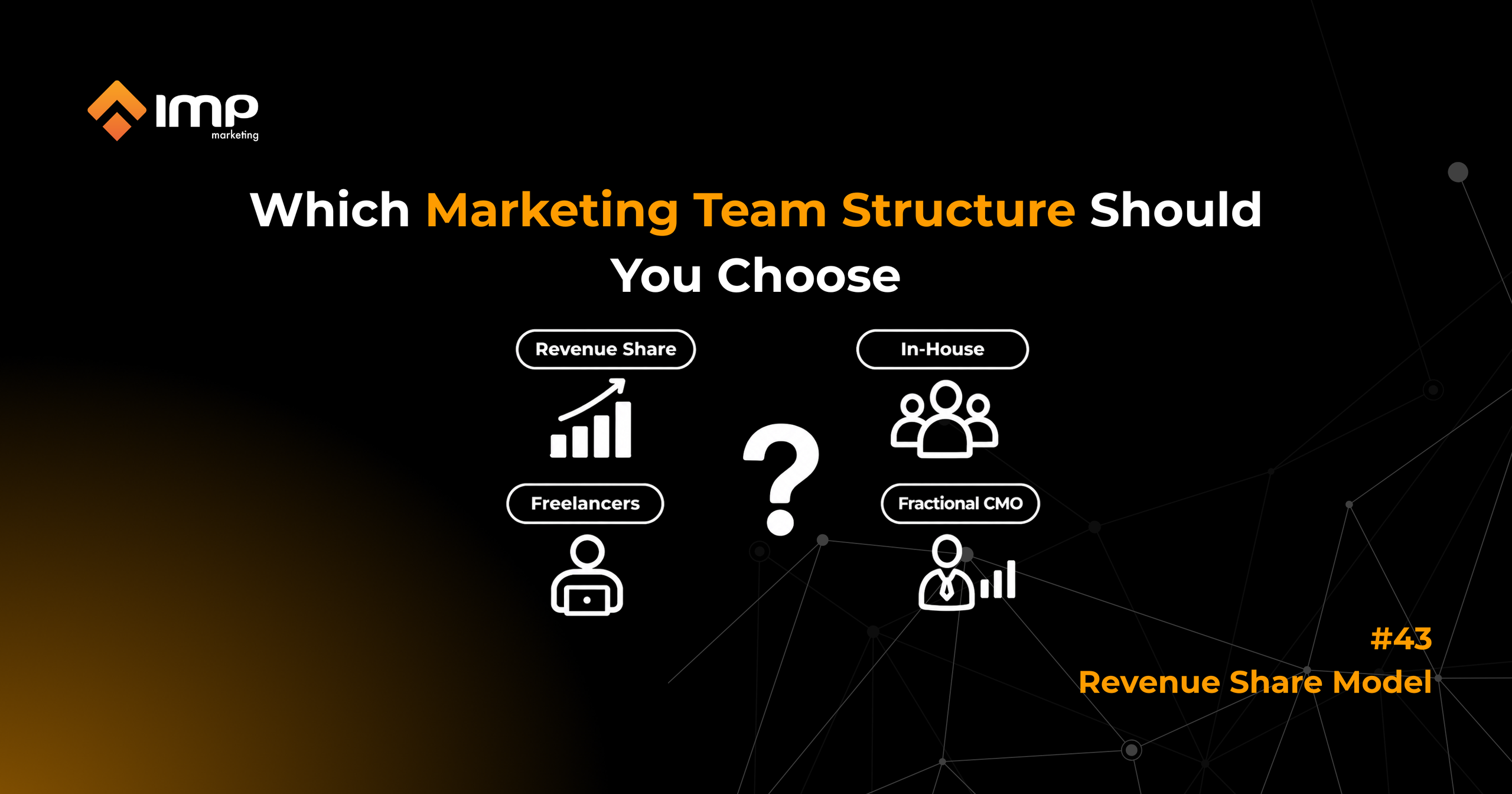
You can build your marketing capability in different ways, from hiring an in-house team or multiple freelancers to combining internal leadership with a retainer agency, a Fractional CMO, or a revenue share marketing agency.
As the CEO of an eCommerce business, you need to decide how much of your budget to allocate to strategy, execution, coordination, expertise, and accountability. This guide compares the main options so you can understand where each structure works best and when a revenue share partnership may make more sense.
1. Should You Work With a Revenue Share Marketing Agency?
A revenue share marketing agency makes sense when you need both strategy and execution without building and managing a full marketing team yourself. Instead of hiring separate people for paid media, Shopify, CRO, retention, creative, and other marketing functions, you work with one team that can bring in the right specialists as your growth needs change.
Revenue share partnerships can use pure performance (commission only) or a hybrid model (a small base fee plus a lower commission). For example, under a hybrid model, a brand generating $100,000 per month with a $5,000 base fee and an 8% revenue share would pay about $13,000 per month.
Because part of the agency’s compensation depends on your revenue, the team has a stronger reason to look beyond individual tasks and focus on the whole growth system. This creates more incentive to solve bottlenecks, adjust strategy, and keep improving performance as your business grows.
Main advantage: You get strategy and execution under one partnership, with part of the agency’s compensation tied to your growth.
Main disadvantage: The trade-off is that revenue share is not suitable for every company. Your business needs enough product-market fit, margin, and growth potential for both you and the agency to benefit from the arrangement.
2. Should You Build an In-House Marketing Team?
An in-house team makes sense when you want to build marketing as a long-term capability inside your company and have enough budget to hire and manage the right people.
The main advantage is control. Your marketers work only for your company. Over time, they learn your products, customers, internal processes, and brand better than most external partners can. That knowledge stays inside the business as long as you retain the team.
The main challenge is cost.
According to Deb Andrews, originally published in August 2026, building a broader in-house marketing function can include the following costs:
← SWIPE HORIZONTALLY TO VIEW FULL TABLE
| Role / Function | Estimated Cost |
|---|---|
| CMO | $23,000–$42,000/month |
| Social Media Executive | $5,000–$10,000/month |
| Paid Media Management | $8,300–$10,400/month |
| Design & Creative | $8,000–$12,000/month |
| Recruiting | 15%–25% of first-year salary |
| Employee Overhead & Benefits (insurance, bonuses, equipment, office, training, team activities) | ~1.25–1.4× base salary |
You can put the first-year investment at roughly $675,000–$1.1 million before media spend, events, and other marketing programs.
You may hire one person to handle two or three marketing functions, but it is difficult to expect one person to manage everything well. Someone who is strong at paid ads may not have the same level of expertise in Shopify management, CRO, retention, or analytics. As your marketing becomes more complex, relying on one generalist can create skill gaps that slow down growth.
If you hire the wrong person, the cycle starts over. If a strong employee leaves, much of the knowledge they built about your business can leave with them.
This is a good model for larger companies, but it can be much harder for SMEs.
If building and managing a full internal team feels too expensive for your current stage, a revenue share marketing agency can cost less per month than hiring one experienced marketing employee, while giving you access to an entire team of specialists.
Learn more: Revenue Share Marketing Agency vs In-House Team.
3. Should You Build Your Marketing Team With Multiple Freelancers?
Multiple freelancers make sense when you already have a clear marketing plan and only need specialists for specific tasks.
For example, you might hire one freelancer for paid media, another for email marketing, a designer for creative, and a Shopify developer when technical work is needed.
The financial advantage is flexibility. You pay only for the work you need instead of carrying full-time salaries and overhead. This can be particularly efficient when you need only one or two specialists.
The model becomes more difficult as your marketing grows more complex.
Your media buyer may see a conversion problem. Your Shopify developer may need new creative. Your email marketer may need customer data from another system. Each freelancer can be good at their own job, but someone still has to decide priorities and connect all of their work.
That person is usually you or someone on your internal team.
As you add more freelancers, you are therefore adding not only freelancer costs but also coordination and management.
Main advantage: You can access specialized skills without committing to permanent hires.
Main disadvantage: You remain responsible for strategy and for making sure all the specialists work together.
Multiple freelancers are a strong option when you already have marketing leadership internally and need flexible execution in specific areas.
If you need several specialists but do not want to manage and coordinate them separately, a revenue share agency can bring those functions together under one team. Instead of managing multiple people yourself, you usually work through one account lead who coordinates the specialists for you.
Learn more: Revenue Share Marketing Agency vs Multiple Freelancers: Which Is Better for Growth?
4. Should You Hire a Fractional CMO?
A Fractional CMO makes sense when you already have an execution team but need a senior expert to provide strategy, direction, and advice.
For example, you have a designer, performance marketer, content specialist, or eCommerce marketer. The problem is that nobody is looking across the entire marketing function and deciding what the team should prioritize.
A Fractional CMO can provide that leadership without the cost of hiring a full-time CMO. They can analyze performance, set strategy, allocate priorities, and help your existing team make better decisions.
Based on estimates from Deb Andrews, originally published in August 2026, a Fractional CMO setup could look like this:
← SWIPE HORIZONTALLY TO VIEW FULL TABLE
| Marketing Resource | Estimated Monthly Cost |
|---|---|
| Fractional CMO | ~$12,000 |
| Creative Content Specialist | ~$9,000 |
| Graphic Designer | ~$7,000 |
| eCommerce Marketing Specialist | ~$10,000 |
| Performance Marketer | ~$8,000 |
| Estimated Total | ~$46,000/month before tax and overhead |
When you hire a Fractional CMO, you still need people who can execute the strategy. Execution does not always go exactly as planned, so the team needs to adjust based on actual performance. If you want the Fractional CMO to stay involved in implementation as well, you may need to pay an additional hourly or execution fee, depending on the agreement.
Main advantage: You get senior marketing leadership without hiring a full-time CMO.
Main disadvantage: Strategy and execution may remain separate, so you still need to manage a capable team to implement the plan.
Learn more: Revenue Share Marketing Agency vs Fractional CMO: Which Model Fits Your Business?
5. Should You Hire a Retainer Marketing Agency?
A retainer marketing agency makes sense when you know which marketing services you need and want to pay a fixed monthly fee for an agreed scope of work.
Unlike a revenue share agency, a retainer agency is mainly paid to deliver the services you agreed on, whether those activities directly increase your revenue or not.
The cost of a retainer agency depends on the services and scope you need. According to WebFX’s 2026 pricing data, typical agency costs can range
← SWIPE HORIZONTALLY TO VIEW FULL TABLE
| Marketing Service | Estimated Monthly Cost |
|---|---|
| Ads Management | ~$10,000 |
| Content Marketing | ~$10,000 |
| Email Marketing | ~$5,000 |
| Social Media Marketing | ~$5,000 |
| Total | ~$30,000/month |
You may not need every service at once, but the more services you add, the more your monthly cost can increase. If you hire an agency for paid media but later need help improving Shopify conversion, for example, that work may require an additional scope and fee.
Main advantage: You get professional marketing support with a clear scope and predictable monthly cost.
Main disadvantage: Additional marketing needs can mean additional scope and fees.
Learn more: Commission-Based Marketing Agency vs Retainer Agency: What Is the Difference?
Which Marketing Team Structure Should You Choose?
The simplest way to choose is to look at what your business already has and what it is missing.
← SWIPE HORIZONTALLY TO VIEW FULL TABLE
| Your Situation | Structure to Consider |
|---|---|
| You have the budget and want to build permanent marketing capabilities internally | In-House Team |
| You already have strategy and only need specific specialists | Multiple Freelancers |
| You already have people who can execute marketing but need an expert to give you strategic advice and direction. | Fractional CMO |
| You know which ongoing services you need and want a defined external scope | Retainer Agency |
| You need strategy and execution together without building the entire team internally, and you want the peace of mind of knowing that an experienced team is managing your marketing. | Revenue Share Marketing Agency |
You need to choose the structure that fills the gaps in your business without creating more cost, management, or complexity than you need.
If your main challenge is not just finding people to do marketing but having one team take responsibility for both strategy and execution, a revenue share partnership may be the strongest fit.
Revenue Share Marketing Team Structure FAQ
1. When does a revenue share marketing agency make more sense than building a full internal team?
A revenue share marketing agency can make more sense when a business needs both strategy and execution but does not yet want to hire and manage a full internal marketing team. Instead of recruiting separate specialists for paid media, CRO, Shopify, retention, and creative, the brand can access those capabilities through one partnership. This can reduce management complexity while keeping part of the agency’s compensation tied to measurable business growth.
2. What should a business already have before working with a revenue share marketing agency?
A business should ideally have product-market fit, healthy margins, reliable revenue data, and enough growth potential to support a revenue share partnership. The model works best when there is already proven customer demand and a clear opportunity to scale. Without those foundations, it becomes harder for both sides to separate product issues from marketing issues and build a sustainable growth plan.
3. How does a revenue share marketing agency reduce marketing management complexity?
A revenue share marketing agency can reduce management complexity by bringing strategy, execution, and multiple marketing functions under one team. Instead of coordinating separate freelancers, specialists, and external partners, founders usually work through one lead who connects paid media, creative, retention, CRO, and other growth activities. This creates clearer accountability and makes it easier to adjust priorities as the business grows.