Revenue Share Marketing Agency: Red Flags and Green Flags to Watch Before Signing

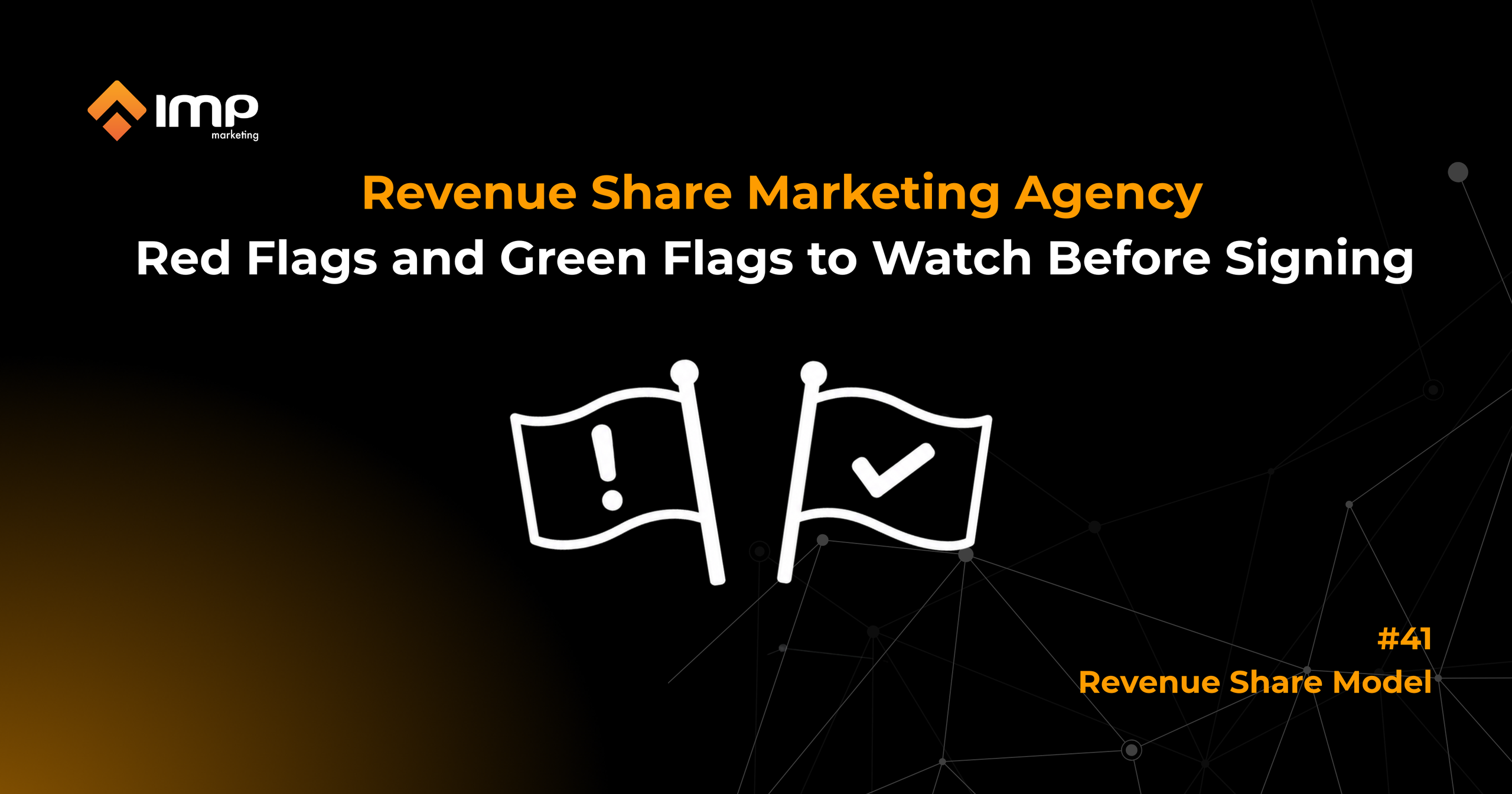
The biggest red flags to watch for before signing with a revenue share marketing agency are unrealistic promises, unclear communication, weak reporting, an inexperienced team, and recommendations that benefit the agency more than your brand.
The strongest green flags with signals: transparent communication, clear reporting, proven expertise, a capable team, and a willingness to share both the upside and downside of growth.
Because a revenue share agency earns more when your business grows, the partnership should create real alignment, not just a different payment structure. Before signing, you need to look at how the agency works, who will manage your brand, how decisions are made, and whether the contract protects both sides. Here is what to look for before signing an agency contract.
1. Does the Agency Set Realistic Expectations?
A good agency should be confident in what it can do without promising results that no one can guarantee.
Red Flags
- The agency guarantees aggressive revenue growth within a very short period.
- It makes big promises before understanding your current revenue, product resources, and marketing performance.
- It focuses only on the potential upside without explaining the risks or what could slow down growth.
Green Flags
- The agency sets realistic targets based on your current performance and growth potential.
- It is clear what it can influence and what it cannot guarantee.
- It explains both the opportunities and risks before asking you to commit.
2. Does the Agency Communicate and Report Clearly?
Good communication means you always know what the agency is working on, how performance is going, and what comes next.
Red Flags
- You constantly need to ask the agency for updates.
- Projects fall behind, and no one gives you a clear explanation.
- Reports show what the team did but do not explain what happened to revenue or performance.
- Deadlines, responsibilities, and next steps are not clear.
Green Flags
- The agency keeps you updated with the most important metrics and key activities.
- Every project has clear owners, deadlines, and next steps.
- Reports and dashboards make it easy to understand what is really happening with the business
- If something is not working, the agency brings it up early and tells you what it plans to do next.
If ROAS falls, conversion rate declines, or a campaign does not perform as expected, a good agency should explain what happened and what it plans to do next instead of trying to make the report look better than reality.
3. Does the Agency Make Decisions That Are Good for Your Brand?
A revenue share marketing agency can still hit its own performance targets while making decisions that are not financially healthy for your business. For example, an agency may increase ad spend to generate more revenue instead of first optimizing the campaigns to use your existing budget more efficiently.
Red Flags
- They push higher ad spend without considering whether the additional revenue is profitable.
- They focus heavily on revenue while ignoring ROAS, margins, or operational risks.
Green Flags
- The agency considers revenue, ROAS, margins, and long-term growth together.
- They are willing to recommend spending less when additional spending no longer creates healthy growth.
A true growth partner should be willing to protect your margins. Even if it means the agency earns less, it should still adjust the plan to reduce pressure on your profit.
4. Who Will Actually Work on Your Brand?
A person you meet before signing may not be the team that actually works on your brand. Sometimes, senior people join the sales meetings, but after the contract starts, most of the work is handed to one junior person with limited support.
Red Flags
- Senior strategists appear during the pitch but disappear after you sign.
- One junior employee is responsible for almost everything.
- Junior team members have to make important decisions without enough senior support.
Green Flags
- You know who will work on your brand before the partnership starts.
- Senior expertise remains available when important strategic decisions need to be made.
- The agency allocates enough people and resources as your needs grow.
Before signing, ask who will actually work on your brand, what each person is responsible for, and how senior team members will stay involved. This helps you understand whether the agency has enough experience and resources to support your account properly.
5. Does the Agency Have the Skills Your Brand Needs to Scale?
An agency needs to have the skills from strategy to execute to be a true growth partner and help you scale. Sometimes things don’t go as planned when executing. So the revenue share team has to have enough range and enough experience to be close to your brand, to make adjustments when something changes, and to recommend the next best move based on what is actually happening.
Red Flags
- The agency treats every growth problem as an advertising problem.
- The team is strong in only a few areas and lacks the full-stack capabilities needed to support growth end to end.
- It cannot identify whether the real bottleneck is acquisition, conversion, retention, or another aspect of the business.
Green Flags
- The agency keeps testing new approaches but does not chase every trend without a clear business reason.
- The team can adjust both the strategy and execution when results do not go as planned.
- It keeps up with useful technologies, automation, and AI instead of relying only on old playbooks.
6. Can the Agency Prove Its Experience?
When you want to know whether an agency can really prove its experience, look beyond what it says in the pitch. Ask to see previous performance reports, measurable results, and feedback from past clients. The goal is to find evidence that the agency has successfully handled similar responsibilities before.
Red Flags
- Case studies make impressive claims without showing meaningful numbers.
- The agency cannot explain how previous results were achieved.
- It claims expertise that it cannot demonstrate.
- Testimonials are vague or difficult to verify.
Green Flags
- Case studies include measurable results.
- The agency can show previous reports or other evidence behind its results.
- Certifications, partner badges, or recognition from reputable platforms support its expertise where relevant.
- The agency has a track record with relevant brands or similar growth challenges.
Before signing, focus on the results, data, and client experiences behind what the agency tells you.
Conclusion
Most importantly, pay attention to what motivates the agency after the contract is signed. Whether you choose a retainer, project fee, or revenue share partnership, the best relationship is one where both sides can make decisions that support healthy, sustainable growth.
A good agency should not only be there when things are going well. It should be willing to share accountability, communicate when things are difficult, and work with you toward a result where both sides can win together.
Revenue Share Marketing Agency FAQ
1. How can founders tell whether a revenue share marketing agency is truly aligned with their business?
Founders should look at how the revenue share marketing agency makes decisions when growth becomes more difficult. Strong alignment means the agency considers revenue, ROAS, profit margins, operational risks, and long-term growth together instead of simply pushing for more spend. A good sign is when the agency is willing to recommend spending less if additional budget is no longer creating healthy growth.
2. What should founders verify about the team before signing with a revenue share marketing agency?
Founders should verify who will actually work on the business, what each person is responsible for, and how senior team members will stay involved after the contract is signed. A revenue share marketing agency should have enough strategic and execution support to handle changing growth problems instead of leaving major decisions to one junior team member without sufficient support.
3. What proof should a revenue share marketing agency provide before a founder signs?
A revenue share marketing agency should be able to support its claims with measurable case studies, previous performance reports, relevant client experience, and clear explanations of how results were achieved. Founders should look beyond impressive numbers and understand the strategy, execution, and business conditions behind those results. Strong evidence makes it easier to evaluate whether the agency has handled similar growth challenges before.