Top 6 Marketing Agency Pricing Models: Which One Is Right for Your Brand?

Today, agencies use several different pricing models, from hourly rates and fixed retainers to performance-based fees. Each pricing model creates different incentives, levels of accountability, and ways of sharing risk between the agency and the client. This guide explains the most common digital marketing agency pricing models, how each one works, when businesses typically use them, and the advantages and disadvantages you should understand before choosing an agency.
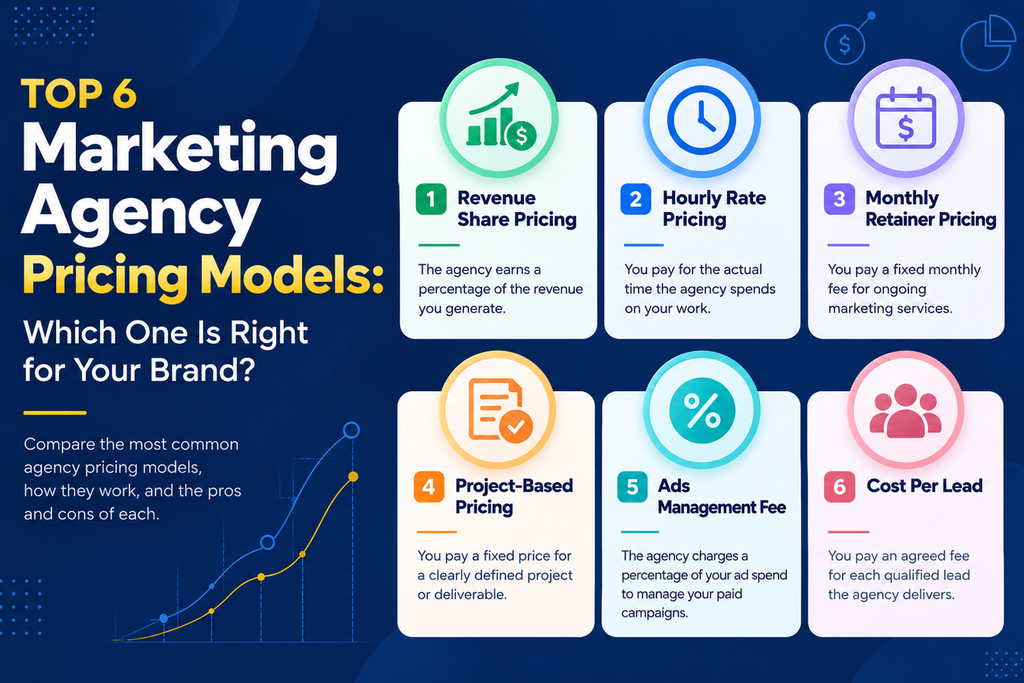
1. Revenue Share Pricing
What Is Revenue Share Pricing?
The Revenue Share Model is a performance-based pricing model in which the agency earns an agreed percentage of the revenue generated. Built on a skin-in-the-game mindset, it aligns the agency’s compensation directly with your business growth. So, the agency operates as a true growth partner that is motivated to solve bottlenecks and continuously drive revenue.
Pros
- The agency earns more when your business grows, keeping both sides focused on the same goal.
- “Skin in the game” encourages the agency to take more ownership beyond agreed deliverables.
- Lower fixed costs allow you to pay more as the business generates more revenue.
- The agency stays motivated to find new growth opportunities over the long term.
Cons
- Both sides need transparent and reliable revenue data.
- Revenue definitions, reporting dates, and share percentages need to be clearly agreed on.
- The model works best when your products have already achieved product-market fit and healthy profit margins.
How Agencies Usually Charge
Revenue share agreements typically define three elements before the partnership begins:
- The revenue metric used for calculating revenue share (such as Gross Revenue or another agreed metric).
- The revenue share percentage paid to the agency.
- The reporting schedule used to reconcile revenue, usually monthly.
For example, if your business generates $50,000 in monthly revenue and both sides agree on an 8% revenue share, the agency fee would be $4,000 for that month. Some agencies also combine a smaller monthly retainer with revenue share to balance risk for both parties. The exact percentage and fee structure can vary by partnership, which we explain in more detail in How Are Revenue Share Rates Structured In Marketing Partnerships?
2. Hourly Rate Pricing
What Is Hourly Rate Pricing?
Hourly Rate Pricing is a time-based model where you pay the agency a set rate for every hour the team works. The final cost depends on the number of billable hours required, making this model straightforward for consulting, short-term support, or projects where the scope is difficult to define in advance.
Pros
- You pay based on the time the agency actually spends on your work.
- The model is flexible when your scope or workload changes frequently.
- It works well for consulting, audits, and smaller tasks that do not require an ongoing partnership.
Cons
- Your final cost can be difficult to predict when a project requires more hours than expected.
- You may need to track the agency’s hours to understand what you’re paying for.
- Paying for more hours does not guarantee better results or more revenue.
How Agencies Usually Charge
The agency sets an hourly rate and tracks the time its team spends on your brand. Different specialists may also have different rates depending on their role and experience.
According to Clutch’s 2026 pricing data, advertising agencies typically charge around $100–$149 per hour. For example, if an agency charges $125 per hour and spends 20 hours on your project, your agency fee would be $2,500.
3. Monthly Retainer Pricing
What Is Monthly Retainer Pricing?
Monthly Retainer Pricing means paying a fixed monthly fee for ongoing marketing services. You know what support is included and can plan your marketing costs more easily.
Pros
- You know your agency fee in advance, making monthly marketing costs easier to budget.
- Your agency can continuously work on campaigns instead of starting a new contract for every task.
- Long-term collaboration allows the agency to build a deeper understanding of your brand over time.
Cons
- You may still pay the same monthly fee during months when less work is required.
- The agency’s compensation is not directly tied to the revenue or results it generates.
- Work outside the agreed scope may require additional fees or a new agreement.
How Agencies Usually Charge
With a monthly retainer, the agency sets a fixed recurring fee based on the agreed scope of work, services, and level of support. According to MarketerHire, full-service agency retainers with senior strategists can range from $15,000 to $50,000+ per month, depending on the scope and agency tier.
For example, a business may agree to pay $50,000 per month for ongoing support across paid media, creative, email marketing, CRO, and strategy. The business pays the agreed $50,000 monthly retainer regardless of whether revenue increases or decreases during that month, unless the scope or agreement changes.
4. Project-Based Pricing
What Is Project-Based Pricing?
Project-Based Pricing, also called fixed-fee pricing, means you pay an agreed price for a clearly defined project rather than paying for every hour worked. The agency and client normally agree on the scope, deliverables, and total cost before the project begins.
This model works best when the final deliverable can be clearly defined, such as a website redesign, brand identity, marketing audit, or campaign setup.
Pros
- You know the total project cost before the work begins.
- Clear deliverables make it easier to understand what you are paying for.
- The agency can focus on completing the project efficiently.
Cons
- Changes during the project can lead to additional fees when they fall outside the original scope.
- The model is less flexible when your priorities change during execution.
- The engagement may end after delivery, so ongoing optimization is usually not included.
How Agencies Usually Charge
According to Swydo’s 2026 agency pricing data, simple website projects typically range from $5,000 to $15,000, while larger projects and mid-range campaigns can range from 50,000 to $500,000+.
For example, an agency may charge $20,000 for a website redesign with an agreed number of pages, features, revisions, and deliverables. You know the project fee before the work begins, but if you later request additional pages, features, or other work outside the original scope, the agency may quote those changes separately.
5. Ads Management Fee
What Is an Ads Management Fee?
An Ads Management Fee is a pricing model where the agency charges you a percentage of your advertising spend to manage your paid campaigns. The more you spend on ads, the more you pay the agency.
According to Ryze AI, agencies commonly charge 10–20% of monthly ad spend under this model.
Pros
- Lower management fees when your advertising budget is still small.
- The fee is easy to calculate because it is based directly on your monthly ad spend.
- As your ad budget grows, the agency earns more and can dedicate more resources to managing a larger, more complex account.
Cons
- The model can become expensive as your advertising budget scales.
- The agency earns more when you spend more on ads, regardless of how efficiently that budget performs.
How Agencies Usually Charge
For example, if you spend $10,000 per month on ads and the agency charges 15%, you pay $1,500 in management fees. If the agency recommends increasing your budget to $30,000, its fee increases to $4,500.
6. Cost Per Lead
What Is Cost Per Lead Pricing?
Cost Per Lead (CPL), also called Pay Per Lead, is a performance-based pricing model where you pay the agency an agreed fee for each qualified lead it delivers. You pay when a prospect meets the qualification criteria agreed upon between you and the agency.
For example, a qualified lead might need to match your target location, customer profile, and level of buying intent. The clearer this definition is, the easier it is for both sides to determine which leads should be paid for.
Pros
- You pay for qualified leads delivered rather than the agency’s time or marketing activity.
- Your cost is easy to calculate because each qualified lead has an agreed price.
- The agency is motivated to generate more leads that meet the agreed qualification criteria.
Cons
- Qualified leads do not necessarily become paying customers.
- You still need a sales team to turn those leads into customers. If your team cannot close them, you may pay for many leads without generating enough sales.
How Agencies Usually Charge
You and the agency agree on what counts as a qualified lead and how much you will pay for each one.
For example, if you agree to pay $100 per qualified lead and the agency delivers 50 qualified leads, you pay $5,000. If the agency delivers 100 qualified leads, you pay $10,000.
Conclusion
There is no single agency pricing model that works best for every brand. The right choice depends on what you need from the agency, how predictable you want your costs to be, and how closely you want the agency’s incentives tied to your business results.
Hourly and project-based pricing can work well for clearly defined or short-term work, while retainers are better suited to ongoing support. Performance-based structures such as revenue share create stronger alignment when measurable growth is the priority.
Before choosing an agency, look beyond the fee itself and consider what the pricing model motivates the agency to do. The best structure is one that gives both sides a clear reason to work toward the same business goals while keeping costs, responsibilities, and expectations transparent.
Revenue Share Agency Pricing FAQ
1. Why does the pricing model affect how a marketing agency behaves?
The pricing model affects agency behavior because it determines what the agency is financially rewarded for. In a revenue share partnership, compensation increases when the business generates more revenue, which gives the agency a direct reason to focus on growth, solve bottlenecks, and continue looking for new opportunities. This is why founders should evaluate not only how much an agency charges, but also what behavior the pricing structure encourages.
2. What should founders agree on before starting a revenue share pricing model?
Before starting a revenue share pricing model, founders and the agency should clearly define the revenue metric, revenue share percentage, reporting schedule, and how revenue will be reconciled. Both sides should also understand which parts of the business are included in the agreement. Clear definitions from the beginning help reduce future disagreements and make the revenue share partnership easier to manage long term.
3. When does revenue share pricing make the most sense for a brand?
Revenue share pricing makes the most sense when the business already has product-market fit, healthy margins, reliable revenue data, and clear room for further growth. The model also works better when both sides can communicate transparently and measure business performance consistently. These conditions give the revenue share marketing agency a stronger foundation to invest in growth while keeping compensation tied to measurable business results.