Top 8 Pay-Per-Performance Partnership Models: Which One Fits Your Business?

As you explore pay-per-performance agency models, you will find several ways to connect marketing fees with measurable outcomes. Some models reward clicks or qualified leads, while others tie compensation to meetings, customer acquisition, completed sales, or revenue growth. Understanding these differences can help you identify which structure best fits your business needs. In this guide, we will break down eight common models, explain where each works best, and share practical considerations to help you choose a partnership that delivers stronger and more sustainable results.
What Is a Pay-Per-Performance Partnership Model?
A pay-per-performance partnership model gets paid based on the results it helps create. Instead of charging mainly for hours worked or content delivered, its fee is linked to outcomes such as leads, conversions, sales, or revenue growth. This gives the agency a strong reason to focus on activities that can directly support the sales pipeline and improve business performance.
In comparison, a retainer agency charges a fixed monthly fee based on an agreed scope of work, even when campaign results change. That is why it is important to understand what each model rewards before choosing where to invest your marketing budget.
Pay-per-performance pricing can make the relationship clearer because both sides agree on the results that matter and how those results will be measured.
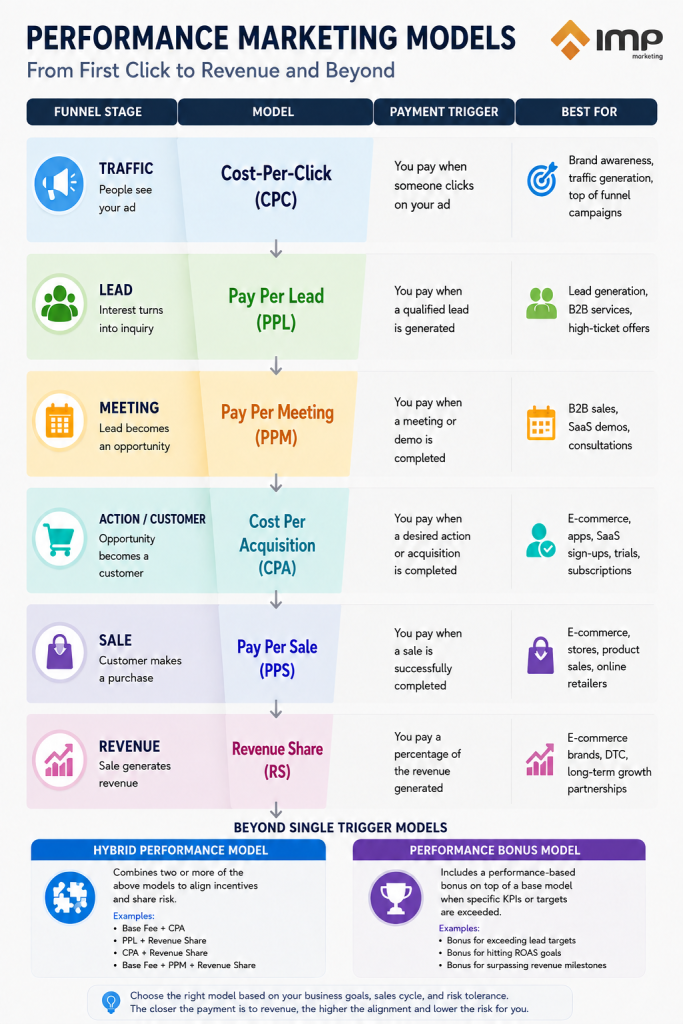
1. Revenue Share model
Before looking at the other pricing models, it’s helpful to understand the Revenue Share model because it represents one of the most comprehensive forms of pay-per-performance marketing.
A revenue share model usually includes a base fee plus an agreed percentage of the revenue generated during the partnership. The base fee supports ongoing execution, while the performance fee grows with revenue. Both sides must clearly define which revenue is included, how it will be tracked, and whether refunds, discounts, or returns will be deducted. This makes the payment structure easy to understand, but it also requires transparent sales data.
Best for
Revenue Share works best for businesses that already have product-market fit, healthy margins, and transparent sales tracking. It is particularly suitable for eCommerce brands because customer journeys, transactions, and revenue attribution can be measured more accurately than in many offline industries.
Revenue Share Advantages
- The agency earns more when the business generates more revenue.
- The model encourages attention to acquisition, conversion, retention, and customer value.
- A smaller base fee may reduce the business’s upfront financial commitment.
- The agency has a reason to keep improving performance over the long term.
Revenue Share Disadvantages
- Both sides need access to accurate sales and attribution data.
- Businesses without product-market fit, healthy margins, or reliable tracking may struggle with this model.
2. Cost-Per-Click (CPC) Model
Cost-Per-Click means you pay each time someone clicks on your ad. The main goal of this model is to bring as many relevant visitors as possible to your website, landing page, or product page. Because clicks are easy to track, you can quickly see how much you are paying to attract each visitor.
Best For
CPC works best for businesses that want to increase website traffic, test new audiences, promote a product launch, or build awareness before focusing on deeper conversion goals.
CPC Advantages
- Clicks are easy to track across most advertising platforms.
- Businesses can quickly test different audiences, messages, and offers.
- The model can bring targeted traffic to a website in a short period.
- Campaign budgets can be adjusted or paused easily.
CPC Disadvantages
- A click does not guarantee a lead, customer, or sale.
- Businesses may pay for visitors who leave without taking action.
- Poor targeting can quickly waste the advertising budget.
3. Pay Per Lead (PPL) Model
A Pay Per Lead model pays the agency for each lead that meets agreed criteria. A lead may be someone who submits a form, requests a quote, downloads a resource, or provides contact information. Compared with CPC, this model moves further down the funnel because the visitor has shown a clearer level of interest.
Best For
Pay Per Lead works best for businesses with a sales team that can follow up quickly and convert qualified prospects. It is commonly used in B2B services, education, healthcare, real estate, financial services, consulting, and home services.
Pay Per Lead Advantages
- The business pays for potential sales opportunities rather than general traffic.
- The sales team receives a more consistent flow of prospects.
- The model can work well when the business already has a strong sales process.
Pay Per Lead Disadvantages
- The business may still pay for leads that never become customers.
- Both sides need to agree on what counts as a qualified lead.
- Weak follow-up from the internal sales team can reduce the value of the leads.
Learn more: Revenue Share vs Pay-per-Lead Marketing Agency.
4. Pay Per Meeting Model
A Pay Per Meeting model pays the agency when a qualified sales meeting is booked, attended, or completed, depending on the agreement. It focuses on customers who are willing to speak directly with the business. The agency may support outreach, qualification, scheduling, and reminders before the meeting takes place.
Best For
Pay Per Meeting is most suitable for businesses with high-value products or services that require sales conversations before a purchase. This includes SaaS companies, consultants, recruitment firms, agencies, enterprise software providers, and other B2B businesses.
Pay Per Meeting Advantages
- Meetings usually show stronger buying intent than form submissions.
- The model can reduce the time spent prospecting.
- Meeting quality can be reviewed using clear qualification criteria.
Pay Per Meeting Disadvantages
- A booked meeting does not guarantee a completed sale.
- Some prospects may cancel or fail to attend, which means the meeting may not count for payment depending on the agreement.
- The business still needs a strong sales team to close the opportunity.
- Poor qualifications can fill the calendar without improving revenue.
5. Cost Per Acquisition (CPA) Model
A Cost Per Acquisition model means you pay the agency when a customer completes the final action agreed in the campaign. Unlike Pay Per Lead and Pay Per Meeting, which focus on specific steps in the funnel, CPA can cover whichever final conversion matters most to the business.
Best For
CPA works well for businesses with clearly defined conversion events and reliable tracking. It is commonly used by eCommerce brands, SaaS companies, subscription businesses, mobile apps, and digital service providers.
CPA Advantages
- Campaign performance can be compared using a clear acquisition cost.
- The model encourages agencies to improve targeting and conversion.
- It can make budget planning easier when customer value is already known.
CPA Disadvantages
- Attribution can become difficult when several channels influence the same customer.
- The agency may bring the right customers, but poor website experience, pricing, or sales follow-up can still reduce conversions.
- The agency may reach customers with a low acquisition cost who convert easily, but these customers may not return, stay loyal, or create long-term value for the business.
6. Pay Per Sale Model
A Pay Per Sale model means you pay the agency only when a customer completes a purchase. It is a specific type of CPA in which the agreed acquisition is a completed sale. The fee may be a fixed amount for each sale or a percentage of the sale value.
Best For
Pay Per Sale is best suited to eCommerce businesses, affiliate programs, digital products, and companies with short and trackable buying journeys. It works especially well when transactions can be linked clearly to a campaign or partner.
Pay Per Sale Advantages
- Payment is directly connected to completed transactions.
- The business avoids paying for clicks or leads that do not convert.
- The model encourages the agency to focus on converting purchase-ready customers.
Pay Per Sale Disadvantages
- Returns, cancellations, and refunds can complicate commission calculations.
- The model may not reward work that improves retention or future purchases.
7. Hybrid Performance Model
A Hybrid Performance Model combines a base fee with a performance-based payment. Unlike revenue share, the performance component does not have to be a percentage of revenue. It may be tied to leads, sales, milestones, or other agreed results.
Best For
A hybrid model works well for growing businesses that want stronger agency accountability without moving to a fully performance-based agreement. It is also useful for long-term partnerships that require ongoing work across several marketing channels.
Hybrid Performance Model Advantages
- The performance component keeps the agency focused on measurable results.
- Both parties share more of the financial risk.
- The model can be adjusted to suit different business stages and goals.
Hybrid Performance Model Disadvantages
- The pricing structure can become difficult to understand if too many metrics are included.
- A high base fee may weaken the performance incentive.
8. Performance Bonus Model
A Performance Bonus Model keeps the agency’s normal fee structure and adds an extra payment when agreed targets are reached or exceeded. The bonus may be linked to revenue growth, conversion rate, customer acquisition cost, lead volume, or another measurable outcome.
Best For
The performance bonus model may be suitable if you want to keep a predictable agency fee while offering an additional reward only when specific growth targets are achieved.
Performance Bonus Model Advantages
- The agency has an additional reason to exceed the agreed targets.
- Bonus targets can be updated as the business grows.
- The business only pays an additional bonus when the agency reaches exceptional results, without committing to share future revenue.
Performance Bonus Model Disadvantages
- If the wrong targets are chosen, the agency may earn a bonus for results that do not create meaningful business growth.
- Sales, revenue, or conversion results may be affected by seasonality, discounts, pricing changes, or the sales team, making it harder to determine how much of the result came from the agency.
Conclusion
Every pay-per-performance model has its own advantages and disadvantages. From our experience, several models can work well when the pricing structure matches the needs of the business. Revenue share can be especially valuable for companies that want to reduce upfront risk. You can start with a small base fee, then pay the remaining amount only when the agency generates actual revenue.
At the same time, you can still work with an end-to-end team that supports acquisition, conversion, and retention. This means the partnership is not only focused on bringing in new sales, but also on encouraging customers to return, stay loyal, and create more long-term value for the business.
If you are evaluating a pay-per-performance marketing agency, start by defining the business outcome you want to improve and assessing your current business stage, growth opportunity, and long-term fit. If both sides agree on the right performance metric, it becomes much easier to choose a pricing model that supports sustainable growth.
Pay-Per-Performance Partnership Models FAQs
1. How should a business choose the right performance metric for a pay-per-performance partnership model?
A business should choose a performance metric that closely reflects the outcome it actually wants to improve. Traffic-focused businesses may use clicks, and businesses with strong sales teams may focus on qualified leads or meetings, while eCommerce brands may connect compensation to sales or revenue growth. The clearer the business goal and tracking system are, the easier it becomes to create a pay-per-performance structure that both sides can measure fairly.
2. What happens if a pay-per-performance agency is rewarded for the wrong metric?
The wrong performance metric can push the agency toward results that look good without creating meaningful business growth. For example, optimizing only for low acquisition costs may bring customers who purchase once but create little long-term value. Before starting the partnership, both sides should define what a valuable result actually means for the business and how that result will be measured.
3. Can a pay-per-performance pricing model change as the business grows?
Yes. A pay-per-performance pricing model can be adjusted as the business stage, goals, and performance priorities change. A company may initially focus on leads, meetings, or customer acquisition and later move toward revenue growth or a hybrid performance structure. The important part is keeping the compensation model connected to the business outcome both sides are trying to improve.