eCommerce Product Strategy Case Study: How Customer Insights Led to Nearly 3x AOV (Part 1)

For our beauty client, we began the eCommerce product strategy by reviewing the product lineup to identify an offer that could align with customer needs and cover paid acquisition.
Our research revealed two gaps:
- Product direction: The existing products did not fully reflect the needs of the audience we wanted to reach.
- Pricing: Individual products were priced too low to cover paid acquisition costs.
By August, average order value had increased significantly, about 3x, with many shoppers choosing the new bundle on its own. This case shows how those insights shaped the product, pricing, and offer decisions behind that change.
The Context: A New eCommerce Product Strategy Was Needed for Growth
Before working with IMP, the beauty brand already had an eCommerce website, with lip balm and collagen peptide as its initial hero products. Its target audience was adults aged 25 and older, across skin tones and ethnic backgrounds.
By July, revenue growth had stalled. The average order value was approximately $37, while the paid advertising cost was close to $27 per order.
The Challenge: eCommerce Product Strategy Issues With Pricing and Product Priority
At first, we identified the two different challenges.
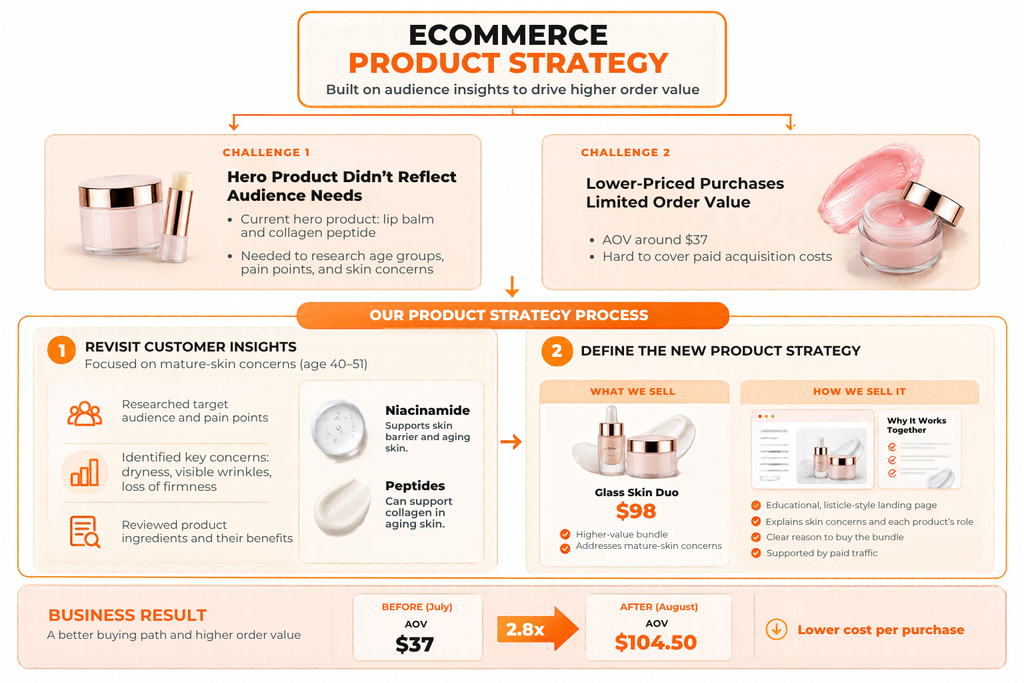
Challenge 1: The Hero Product Needed to Reflect the Target Audience
The key question was whether the current hero product addressed the needs of the customers we wanted to reach. Before building more campaigns around it, we needed to revisit the audience’s age groups, pain points, and skin concerns.
The hero product needed to address a concern that mattered to these customers and offer a relevant solution.
Challenge 2: Lower-Priced Purchases Limited Order Value
With AOV around $37 and individual products priced at $16-$20, the business needed a stronger opportunity for higher-value purchases. Simply selling more of the same low-priced items would leave the value of each order unchanged.
However, a higher-priced offer would only work if shoppers understood its value. The challenge was to create a purchase that made sense for the customer while supporting the brand’s commercial goals.
The Solution: Reshaping the eCommerce Product Strategy Around Customer Insights and Pricing
1. Select a Hero Bundle Around the Audience’s Needs
The brand’s initial target audience was broad: adults aged 25 and older, across skin tones and ethnic backgrounds. To revisit the hero product, we narrowed the audience and reviewed which products could address their concerns. This led us to propose replacing the peptide-and-lip-balm bundle with Glass Skin Duo.
The Research:
During our audience research, we identified concerns about visible signs of aging among middle-aged customers. We explored women aged around 40–51 as a potential customer group and reviewed which products in the catalog might be relevant to their needs (Jamie Ballard, 2024).
A 2024 YouGov survey found that 46% of US women named wrinkles as a skin concern. According to the American Academy of Dermatology, women’s skin loses approximately 30% of its collagen during the first five years of menopause. Skin can also become drier during this transition. Together, these findings gave us specific concerns to guide the product review: dryness, visible wrinkles, and loss of firmness.
The Product Direction:
Two ingredients stood out: niacinamide and peptides. A 2024 scientific review of niacinamide found evidence supporting skin barrier protection and benefits associated with aging skin. The American Academy of Dermatology also includes peptides among ingredients that can support collagen in aging skin.
Niacinamide and peptides stood out as a combination worth prioritizing.
The brand’s previous hero bundle paired a peptide product with lip balm.
Based on this research, we proposed shifting to the Glass Skin Duo, pairing collagen peptide with glass skin serum. This combination brought niacinamide and peptides together in an offer more closely aligned with the mature-skin concerns we had identified.
2. Build a Higher-Value Offer Around the Selected Products
The new strategy connected what we sell with how we sell it.
- What we sell: We brought the niacinamide and peptide products together into a skincare duo priced at $98. This addressed both challenges: it created a higher-value purchase option for the business and gave customers a clearer reason to buy the products together around their mature-skin concerns.
- How we sell it: We paired the bundle with an educational, listicle-style landing page that explained the customer’s skin concerns, each product’s role, and why the combination made sense. For a closer look at this approach, read our companion article: “Product Bundling Case Study: How We Turned the Bundle Into Nearly 3x AOV (Part 2).”
The Result: eCommerce Product Strategy That Increased Order Value
Before: In July, the store’s AOV was approximately $37, limiting the revenue each purchase generated to cover paid acquisition costs.
After: By August, AOV had reached $104.50, approximately 3x the July level. For comparison, that is 54% above LittleData’s current $68 median for Beauty & Skincare Shopify stores.
The higher-value offer gave the business more revenue per order, while cost per purchase also decreased significantly.
The Lesson: Defining eCommerce Product Strategy Through Customer Research
The central lesson was that product selection, pricing, and customer education needed to work together.
Audience research helped determine which concerns should guide the message. That direction informed the products selected for the bundle.
For founders reviewing their eCommerce product strategy with three questions:
- Does the hero product reflect the audience’s needs?
- Does the offer generate enough order value to support customer acquisition costs?
- Does the buying journey clearly explain why the offer is worth purchasing?
When growth stalls, the answer is not always more traffic or a better ad. Sometimes you need to revisit who you are selling to before deciding what you should sell them.
In our next case study, we will break down how we built and sold that bundle and how average order value moved from $37 to $104.50.
If those decisions need a closer look, connect with IMP Marketing to explore how customer insights can guide your product offer and buying journey.
Quick Case Study FAQ
How do you know when a hero product should be changed?
A hero product should be reconsidered when the audience, buying behavior, or business economics no longer support the current choice. A product can still sell well but may not be the strongest option for attracting the next customer segment or supporting a higher-value offer. Regularly comparing the hero product against current customer needs can help prevent the brand from building too much marketing around an outdated assumption.
Should a higher-priced offer replace lower-priced products?
Not necessarily. A higher-value bundle can give shoppers another way to buy without removing the lower-priced products that may still work well as entry points. The important decision is how each offer fits into the product ladder: some products can introduce new customers to the brand, while higher-value offers can serve shoppers who are ready for a more complete solution.
What should brands do when customer research points in a different direction from the current product strategy?
Treat it as a signal to investigate rather than immediately changing the entire catalog. Brands can first test the new direction through messaging, bundles, landing pages, or campaigns before making larger product-development decisions. This creates a lower-risk way to see whether the new customer insight translates into real buying behavior.