How We Set Up a High-Volume Branded Sending Domain After a Rebrand

When our client decided to rebrand, they needed a new branded sending domain to match their identity. We reviewed the previous email setup, where bot spam was a recurring issue, and customer replies could be missed.
From the audit, we identified two key challenges:
- The new branded sending domain had no established sending history. The brand had a large email volume to send, which increases the risk of deliverability or spam issues.
- The new subdomain structure needed to stay easy for the team to manage while still helping subscribers clearly distinguish between different types of emails.
IMP Marketing rebuilt the branded email structure for the new brand, centralized customer replies, and gradually warmed up the new domain before scaling the sending volume. As the setup stabilized, key email metrics recovered to levels comparable to, and even stronger than, the previous setup.
The Context: What Changed for the Branded Sending Domain After the Rebrand?
The client was going through a rebrand, which included changes to its name, website, and domain. The new identity needed to stay consistent across customer touchpoints, including marketing materials and customer communications.
Email was therefore part of the transition. The client needed a new branded sending domain for marketing emails. Under the previous setup, everything was handled through the main domain, with no separate subdomain. The brand was also sending emails to thousands of recipients, so the new setup needed to support high-volume sending without creating unnecessary deliverability risk.
We used the rebrand as an opportunity to rebuild the email setup from the ground up and create a clearer, more structured system.
The Challenge: What Made the New Branded Sending Domain Difficult to Set Up?
The first challenge was sending at high volume. The new branded sending domain had no established sending history, so moving the client’s normal email volume over immediately could increase the risk of deliverability problems or emails being treated as spam. The difficulty was introducing it without disrupting email performance.
The second challenge was how to structure the new subdomain and sender identities. We wanted subscribers to clearly recognize different types of emails, such as campaigns, newsletters, and automated flows. At the same time, the internal setup needed to remain simple enough for the team to manage. Especially customer replies still needed to reach the right place instead of being scattered across multiple inboxes.
The Solution: How Did We Set Up the New Branded Sending Domain?
IMP approached the transition in two stages: first, rebuild the sender structure around the new brand; then gradually introduce the new domain to normal email volume.
1. Rebuild and Warm Up the New Branded Sending Domain
As part of the rebrand, we introduced a new branded sending domain for the client’s marketing emails. Because the new domain had little to no sending history, we could not move the brand’s normal email volume over immediately. Sending too much too quickly could increase deliverability risk. We therefore followed a controlled warm-up process, starting with a smaller sending volume and gradually increasing it.
We therefore followed a controlled warm-up process, starting with a smaller sending volume, prioritizing more engaged subscribers, and gradually increasing the volume over time. This approach follows Klaviyo’s recommended best practices for warming a new sending domain before scaling to normal email volume.
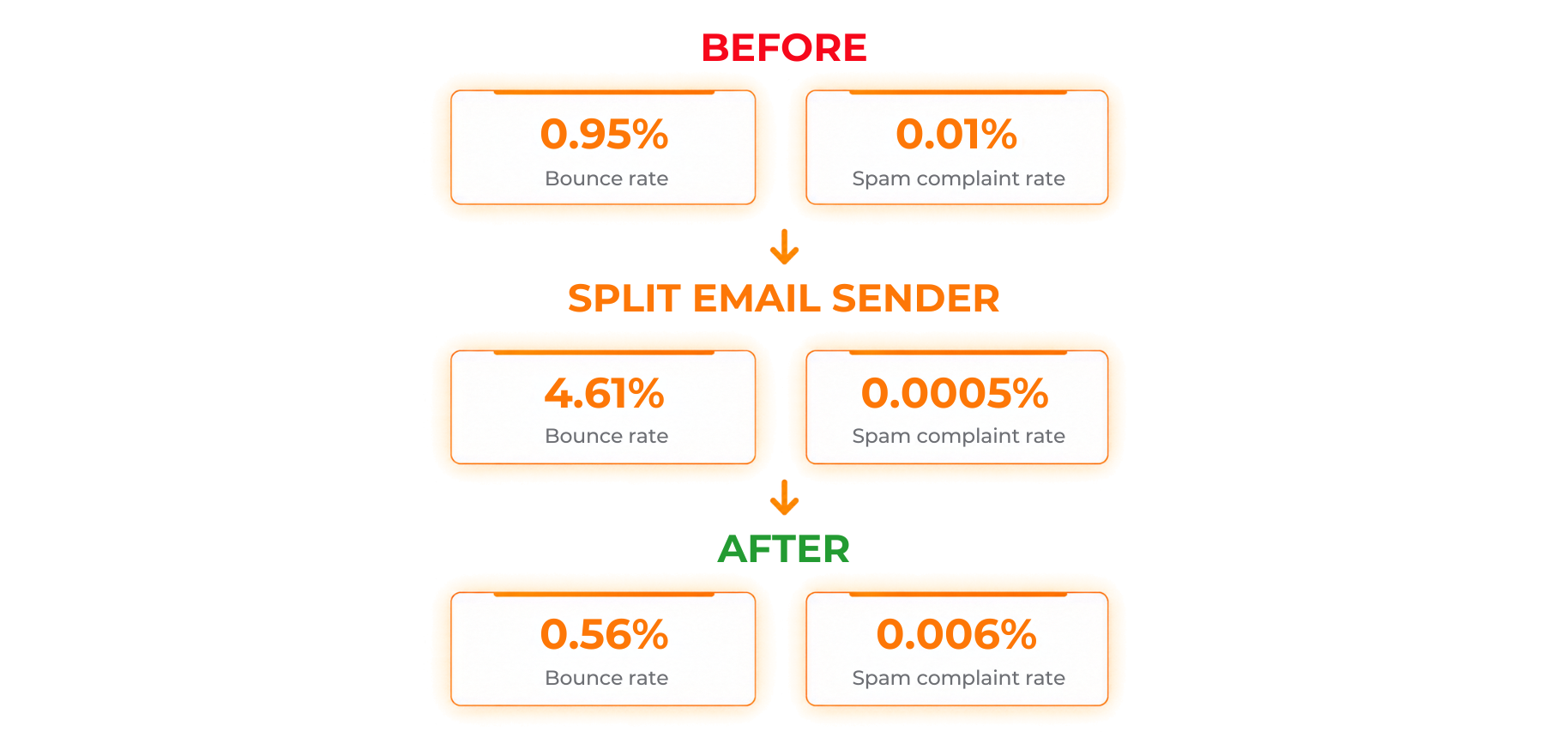
During the transition, the bounce rate increased from 0.95% before the rebrand to 4.56%. This kind of fluctuation can happen when a new sending domain is still building its reputation. At the same time, the new brand identity was still unfamiliar to subscribers, which could affect engagement and how recipients respond to the emails. (Klaviyo, 2025)
Over the following weeks, we continued to adjust the sending volume and monitor performance. By the end of July, the bounce rate had fallen to 0.56%, even lower than the previous rate. In roughly two months, the sharp increase during the transition had been brought back under control.
There was also added pressure behind the process: a major campaign was already planned for August, so we needed the new sending setup to be stable before that campaign began. That created a tight timeline when we needed to prepare quickly enough for the higher-volume anniversary campaign.
By the end of July, the domain had reached a much more stable position, giving the brand a stronger foundation for the campaign planned for August.
2. Organize Different Email Types Under One Branded Sending Subdomain
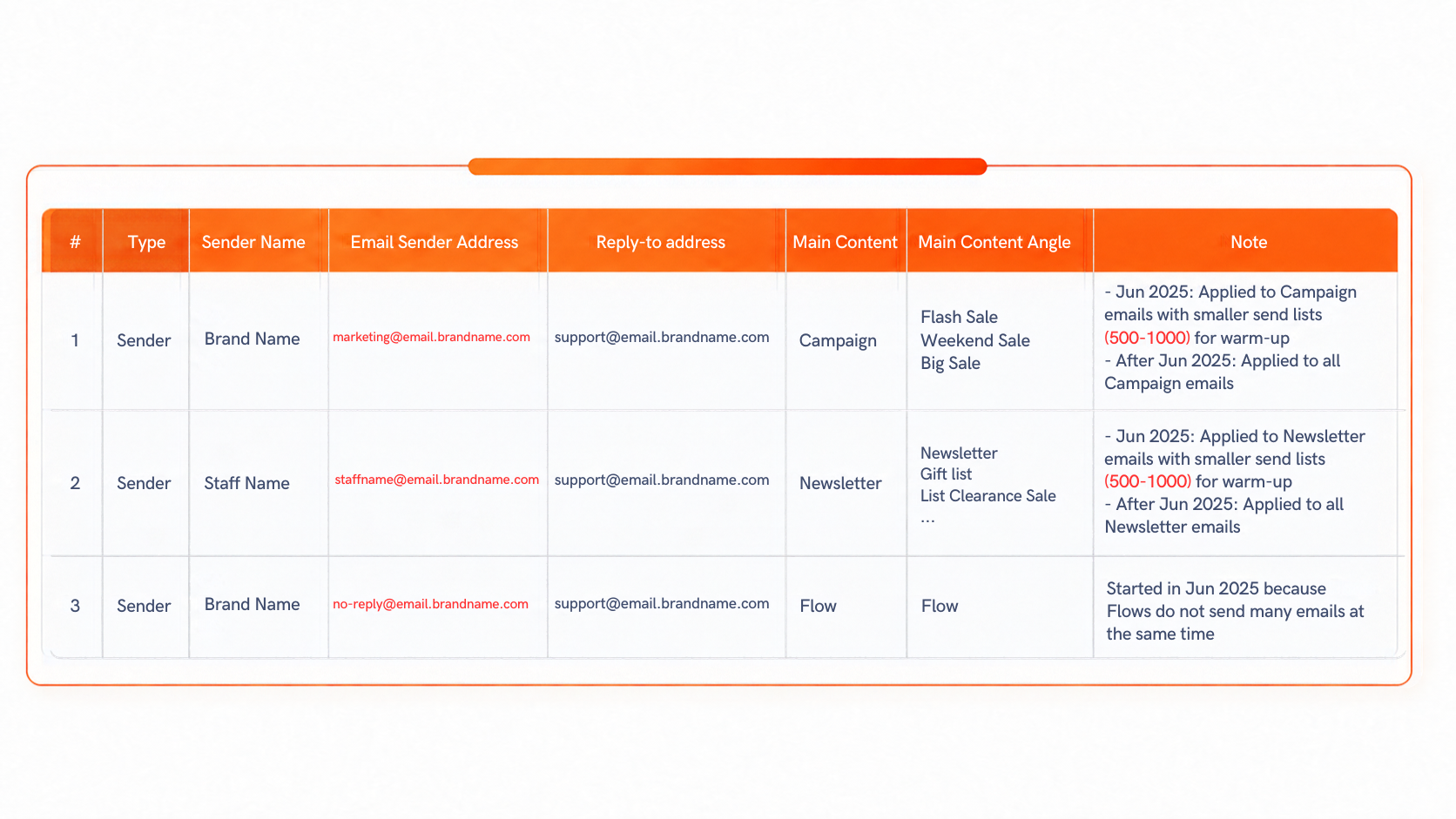
The second part of the rebuild was organizing different sender identities under one branded sending subdomain. We made two major changes:
First, we separated sender identities by email type. Campaign emails used [email protected], newsletters used a more personal address such as [email protected], and automated flows used [email protected]. Different sender names were also used depending on the content. This helped subscribers recognize whether they were receiving a campaign, newsletter, or automated flow.
Second, we moved sender addresses under the same branded sending subdomain. Instead of continuing to send from addresses under the main domain, the new sender addresses all used email.brandname.com. This kept the sender addresses consistent with the branded sending domain in Klaviyo and separated marketing email activity from the brand’s main domain.
All replies were still directed to the same support address, so the client could keep customer communication centralized without managing multiple inboxes.
All sender identities used the same support address, that is [email protected], so customer replies were centralized in one support inbox instead of being split across multiple mailboxes.
During the warm-up period, campaign and newsletter emails were first sent to smaller lists of around 500–1,000 recipients. Automated flows could move to the new structure earlier because they did not send a large volume of emails. When the warm-up period was complete, the new sender structure could be used more broadly.
The Result: What Happened After the New Branded Sending Domain Went Live?
By the end of July, the bounce rate had dropped from its transition peak of 4.61% to 0.56%, below the 0.95% pre-rebrand level. Within roughly two months, the new branded sending domain had reached a much more stable level of performance.
The spam complaint rate decreased from 0.05% to 0.03%, showing that the new sending setup was becoming more stable as the warm-up progressed.
Operationally, the brand also ended up with a cleaner email structure:
- One branded sending setup aligned with the new brand identity;
- Separate sender identities for each email type, including campaigns, newsletters, and automated flows;
- No need to maintain a separate inbox for every sender;
- All customer replies are routed to one real support inbox through the support address.
As a result, the brand had a clearer sending structure for subscribers while keeping customer communication easier for the internal team to manage.
The Lesson: What Did We Learn About a Branded Sending Domain After a Rebrand?
We learned that a new branded sending domain after a rebrand needs to be introduced gradually. It also needs to be monitored closely and adjusted based on how subscribers actually respond.
Sender reputation develops through real sending behavior, so scaling should follow actual performance rather than a fixed timeline. At the same time, the sender structure needs to stay clear for subscribers and simple enough for the internal team to manage efficiently.
Quick Case Study FAQ
1. How do you know when a new branded sending domain is ready for higher email volume?
The decision should depend on how the domain performs as volume increases, including bounce rate, spam complaints, and subscriber engagement. In this case, we kept adjusting the sending volume over several weeks rather than following a fixed schedule.
Upcoming campaigns also need to be considered. In our case, the client had a high-volume anniversary campaign planned for August; we had to build sending reputation steadily while making sure the setup was stable enough before that larger campaign began.
2. Do different sender addresses need separate inboxes?
Not necessarily. A brand can use different sender identities to help subscribers distinguish between campaigns, newsletters, and automated emails without creating a separate inbox for every address.
The visible sender addresses could vary depending on the email type, while customer replies were still routed to one support inbox. This gave subscribers clearer sender context without making reply management more complicated for the internal team.
3. Should you stop using the old email domain immediately after a rebrand?
Not necessarily. The old email setup may still need to stay active during the transition because customers can reply to older emails or use previously saved contact information. Keeping those addresses monitored or forwarding messages to the current support inbox can help avoid missed customer communication while the new brand becomes familiar.