Product Bundling Strategy for a Beauty Brand: How We Increased AOV Nearly 3x

The beauty brand hadn’t identified a hero product it could confidently invest in, and its low average order value (AOV) left too little room to cover customer acquisition costs. IMP Marketing researched what target customers wanted and reviewed the product lineup to find an offer worth promoting.
So we built a product bundling strategy, starting with whether the product actually fits the customers we want to reach. We used customer insights to decide what to sell, then built a buying journey that showed shoppers why the bundle was worth its price.
By August, average order value (AOV) had reached $104.50, nearly 3x the July level, and around 41% of orders were for the new bundle itself. This case study walks through the full process, from the customer insight behind the product to the execution that made it work.
The Context: Why the Brand Needed a New Product Bundling Strategy
Before working with IMP, the beauty brand already had an eCommerce website, with lip balm and collagen peptide as its initial hero products. Its target audience was adults aged 25 and older, across skin tones and ethnic backgrounds. By July, revenue growth had stalled.
The Challenge: Pricing, Product Priority, and Perceived Value in the Product Bundling Strategy
At first, we identified three connected challenges.
Strategy: Choosing and Pricing the Bundle
- Product fit: The client had chosen a peptide and lip balm bundle as its hero offer, but it was still unclear whether that pairing addressed the main skin concerns of the shoppers the brand wanted to reach.
- Order value: Average order value was around $37, while paid ads cost close to $27 per order. That left little room for product costs and other expenses.
Launch: Turning the New Offer Into Sales
- Bundle value: The new bundle was a better fit for the audience, but shoppers still needed to see what each product did and why buying both together was worth it.
The Solution: How Did Our Product Bundling Strategy Shape the Glass Skin Duo Launch?
We addressed the three challenges in two stages. The strategy determined which products to bundle and how to price the offer. The launch showed shoppers why the products made sense together and gave them two ways to explore the same offer.
Strategy: Choosing and Pricing the Bundle
1. Choose a Hero Bundle Around the Audience’s Needs
The client initially chose a peptide and lip balm bundle as its hero offer. When we reassessed it based on customers’ skin concerns, we found that the pairing didn’t fully address their needs. Our research pointed to a more promising option: the Glass Skin Duo.
The Research
During our audience research, we identified concerns about visible signs of aging among middle-aged customers. We explored women aged around 40 to 51 as a potential customer group and reviewed which products in the catalog might be relevant to their needs (Jamie Ballard, 2024). This age range sits around the menopause transition, when these concerns tend to become more noticeable.
A 2024 YouGov survey found that 46% of US women named wrinkles as a skin concern. According to the American Academy of Dermatology, women’s skin loses approximately 30% of its collagen during the first five years of menopause. Skin can also become drier during this transition. Together, these findings gave us specific concerns to guide the product review: dryness, visible wrinkles, and loss of firmness.
The Product Direction
Two ingredients stood out: niacinamide and peptides. A 2024 scientific review of niacinamide found evidence supporting skin barrier protection and benefits associated with aging skin. The American Academy of Dermatology also includes peptides among ingredients that can support collagen in aging skin.
We kept the Collagen Peptide and replaced the lip balm with the niacinamide-based Glass Skin Serum. That gave the new pairing a clearer focus on the concerns we had identified, so we recommended the Glass Skin Duo as the brand’s new hero offer.
2. Order Value: Price the Bundle as a Higher-Value Offer
At a $37 average order value and $27 in ad costs per order, the brand had little left to cover other expenses. We priced the Glass Skin Duo at $98 to increase order value. Next, we needed to show shoppers why the two products were worth buying together.
Launch: Turning the New Offer Into Sales
3. Bundle Value: Show Shoppers Why the Duo Was Worth Buying
At $98, the Glass Skin Duo cost more than twice the brand’s previous average order value. Some shoppers were ready to consider the offer right away, while others needed more context to understand why the two products were worth buying together.
When we launched paid ads on July 15, we ran two paths in parallel to see how shoppers responded to the same offer:
- Offer-led ads highlighted what was included in the bundle and the benefits of using both products together, then took shoppers directly to the product page.
- Educational ads started with skin concerns shoppers might recognize, then directed them to a listicle landing page that explained how each product fit into the routine.
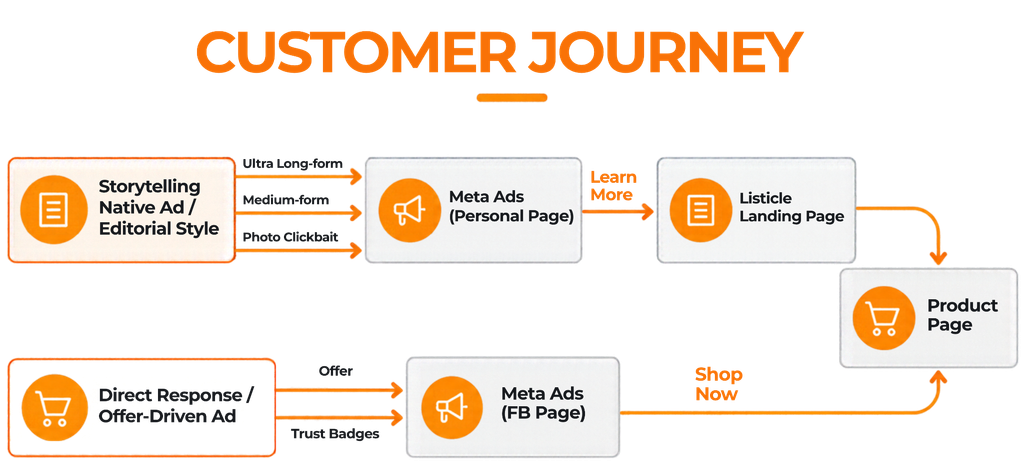
Path 1: Run Direct-Response Ads to the Product Page
The first path followed a traditional ad-to-product-page approach. The ads led with the Glass Skin Duo offer, highlighted what each product did and why the two worked as a routine, and used social proof to build confidence. A “Shop Now” CTA took shoppers straight to the product page, where they could review the $98 offer and buy.
Path 2: Use Educational Ads to Lead Shoppers to a Listicle
Help Customers Recognize Their Menopause-Related Skin Concerns
The first step of the buying journey was to help women in their 40s and early 50s recognize the skin concerns that could become more noticeable at this stage of life.
We used educational posts and paid ads to help shoppers recognize concerns such as dryness, visible wrinkles, and loss of firmness. The ads used editorial-style storytelling, with copy of varying lengths and image-led hooks to spark curiosity. A “Learn More” CTA took shoppers to the listicle to explore those concerns in more detail.
When shoppers understood the concern and saw it as relevant to them, we could move to the next step: explaining which ingredients and products could help address it.
Use a Listicle to Connect Skin Concerns with the Bundle
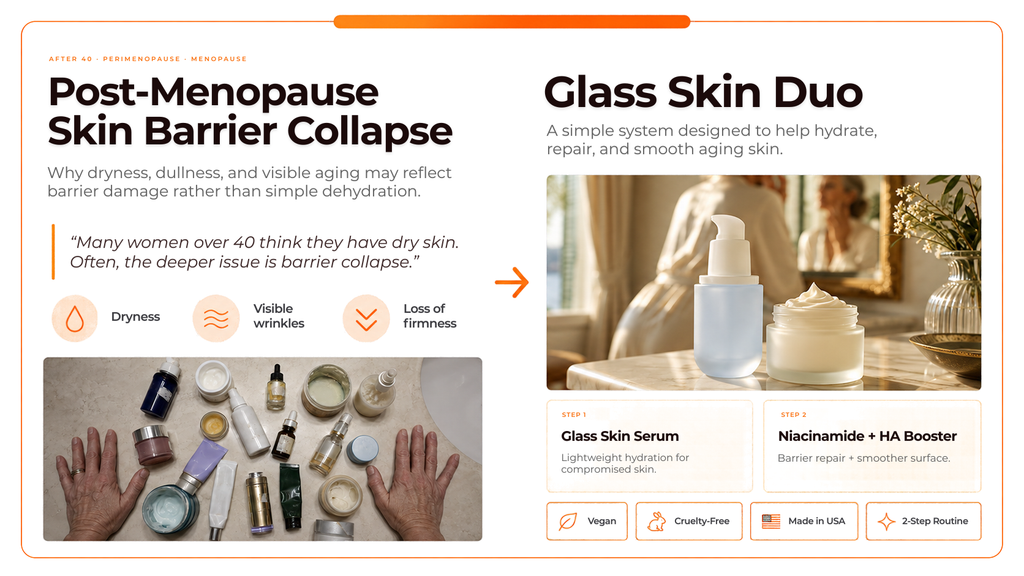
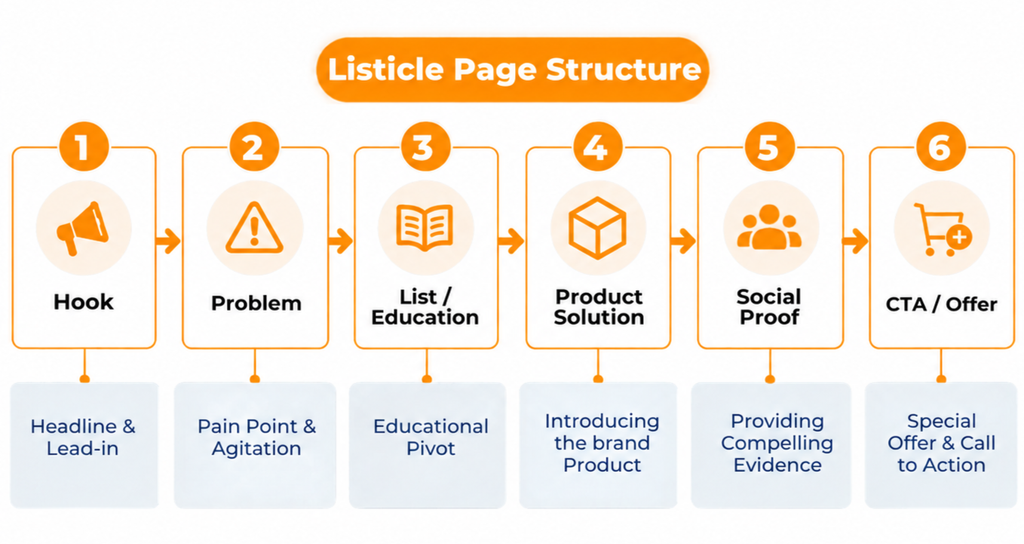
The hook introduced the post-menopause skin changes shoppers might already be experiencing. From there, the problem section explained that the issue could be more than simple dehydration and compared common approaches such as moisturizers and multi-step routines. The education section then introduced three needs behind the proposed routine: deeper hydration, active barrier support, and surface smoothing.
After establishing that context, we introduced the product solution. Shoppers could see the role of each ingredient and understand why the two products belonged together. The Glass Skin Duo was presented as a two-step system combining the Glass Skin Serum with Collagen Peptide.
We then added social proof to reduce uncertainty and show how other customers had experienced the products. The page ended with a clear CTA and bundle offer, supported by a 90-day guarantee to help shoppers feel more confident about the purchase.
When shoppers understood the connection between the problem, the ingredients, and the two products, they could move to the product page with more context for evaluating the $98 offer.
The Result: How the Product Bundling Strategy Changed Average Order Value
Before: In July, the store’s AOV was approximately $37 against roughly $27 in paid cost per order.
After: By August, AOV had reached $104.50, a nearly 3x increase over the July level.
Compared with the industry benchmark, that is 54% above the $68 median for Beauty & Skincare Shopify stores. It also moved much closer to the $120 AOV reached by the top 20% of stores in the category (Littledata, 2026).
More importantly, the order mix showed that the improvement was connected to the new offer. Around 41% of orders during the period were for the Glass Skin Duo itself. This meant a share of shoppers was choosing the exact bundle we had built and educated them around. Cost per purchase also decreased by 51%. Because the bundle and the new buying journey launched together, we cannot attribute the change to either one alone.

The Lesson: What This Product Bundling Strategy Taught Us About Product, Pricing, and Education
The central lesson was that product selection, pricing, and customer education needed to work together.
Audience research determined which concerns should guide the message. That direction informed the products selected for the bundle. Then a complete education journey helped shoppers understand the problem, the role of each product, and the value of choosing the full routine.
For founders reviewing their product bundling strategy, start with three questions:
- Does the hero product reflect the audience’s needs?
- Does the offer generate enough order value to support customer acquisition costs?
- Does the buying journey clearly explain why the offer is worth purchasing?
When growth stalls, the answer is not always more traffic or a better ad. Sometimes you need to revisit who you are selling to before deciding what you should sell them.
If you want to explore how customer insight, product bundling, and the buying journey could work together for your store, connect with IMP Marketing.
Quick Case Study FAQ
Why narrow the audience to women aged 40 to 51 instead of keeping the original 25 and older?
A broad audience makes it hard to pick one concern worth building an offer around. Adults 25 and older cover very different skin needs, so a single hero product rarely speaks to all of them. Narrowing to one group gave us specific concerns to work with (dryness, visible wrinkles, loss of firmness), and those concerns pointed to specific ingredients. Those findings gave us a clear basis for reassessing the client’s original peptide and lip balm bundle and recommending the Glass Skin Duo as a better fit for this audience. A narrower audience does not close the door on others. It gives the brand one clear place to start before expanding.
Besides AOV, what should you track to know a bundle is working?
Look at three things together. First, the share of orders that are the bundle itself (around 41% here), because AOV alone can rise from a few large orders. Second, conversion rate, to see whether the higher price is creating friction. Third, cost per purchase, to confirm the offer is making acquisition more efficient. If AOV rises while conversion rate drops sharply, the bundle may be pricing out too many shoppers.
How do you tell whether the listicle or the direct product page is driving results?
Run both paths with clearly separated ads and CTAs, which is why we used “Learn More” for the listicle path and “Shop Now” for the direct path. That separation lets you compare traffic quality and purchase behavior by path instead of blending everything into one number. Keep in mind that both paths lead to the same offer, and shoppers may see ads from both, so the comparison shows tendencies, not perfect attribution.